
Finding A Place

After a good lunch and some rest, my father’s team set out in search of a place for the new camp. Their host Pesho Yunashkov suggested that there could be a good place close to the ruins of the Roman fortress Dorticum. This first naming of a likely place brought strong associations with the abandoned Km 727. At that memorable place, there was again an archeological site in the vicinity: the ruins of the Roman fortress, Pomodiana. But then, Pomodiana was 4 km. downriver from the camp, whereas in the new place, the suggested camp-site was right by the ruins, they themselves being only 2 km. upriver from the village. Fears of hordes of treasure-hunters assailed the researchers, whose nerves, after the recent goings on near Stanevo, were understandably taut. Pesho did everything to dispel such fears, saying the place was peace itself and no treasure hunters in sight for years. For good measure, he promised to notify the local police about the planned research activities as also the Mayoress of the village, and the Border Guard detachment who were stationed not far from the place, closer to the border with Serbia.
It was obvious that Pesho was a prominent figure locally. Native of the village, but living in Sofia, he had been at some point Vice-Minister of Agriculture and, as he himself kept saying, there was hardly anyone in the village and beyond to whom he hadn’t done some favour. Although long retired, there were immediate and very strong signs that Pesho was still a well-respected local presence.
That afternoon he had asked a fisherman to take the group to the appointed place. A boat duly appeared with a smiling villager at the helm of the outboard. His name was Ferenz (‘Feri’), a Romanian speaker, but equally proficient in Bulgarian. The name was a reminder that the Transylvanian Alps were not that far away, and that the village’s population were practically all of them descendants of 19 c. Romanian migrants.

At relatively low water-level, the beach looked very much like in the previous place, complete with a summer dirt-road connecting Vrav with the eastuary of the border river Timok. There were two more villages between Vrav and the border: Kudelin, and the last one, Balei.
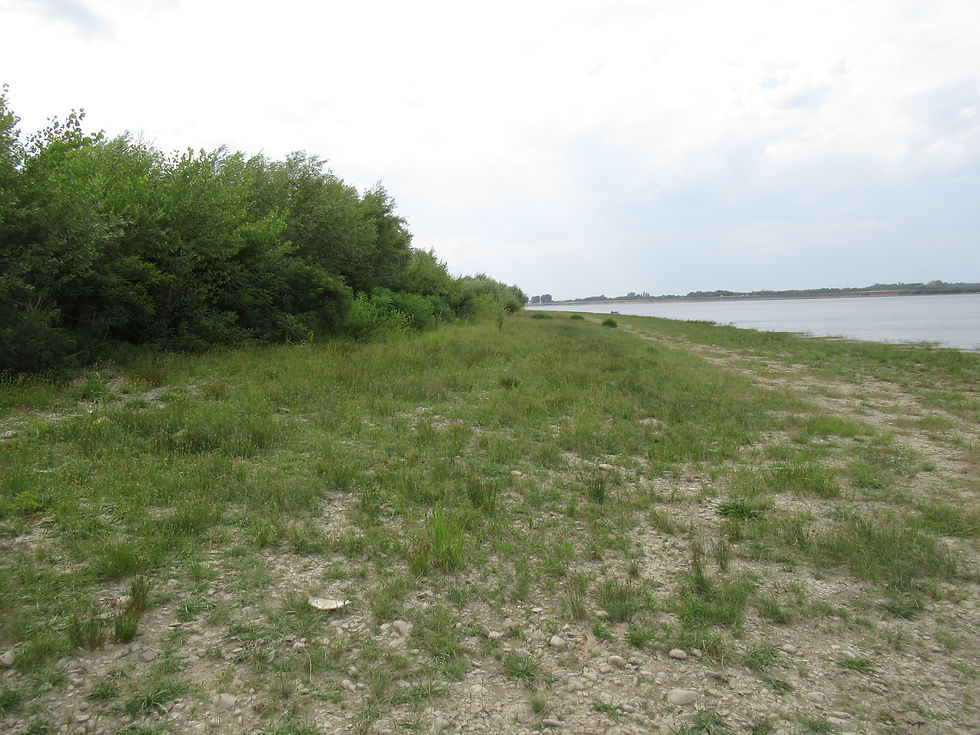


On approaching the place, it became clear that Pesho’s judgement had been very sound. No ruins were to be seen as whatever was there was covered by lush bush and low trees growth. Most attractively, there was again a sedimental loess slope rising steeply from the bank. Feri said that where it levelled out on top an expanse of corn-fields began.
The group disembarked for a closer look.

A convenient place for the big camp-tent looked to be immediately to the right of the bluff. There would be some cutting and trimming of the growth to be done, as well as some leveling of the ground. Blago went through the thicket on that side and reported a dirt-track cutting through it and continuing further on to the fields. He startled some roe-deer when going up, who, shortly afterwards came down to the water-edge to drink from the river. The roe-deer didn’t seem to be much frightened, if at all, which was a welcome sign of low hunting pressure. No doubt the jackals in the vicinity would be of the same mind.

The group turned all their attention to the bluff. The bait-site could be positioned at its foot, and it looked likely that in the lucky case of a jackal family establishing themselves as hosts, their birthing den would be somewhere at the upper edge of the bluff - as it had been at Km 727. Blago went to explore and on coming back said there were numerous holes on the bluff-face, one looking decidedly like entrances to a badger sett in use. Indeed, the entrance could be well seen from the bank with a beaten path leading down.

There was a squall coming up fast from the west, so the whole group scrambled into the boat and Feri took them to the bank near the village in no time at all. An advantage compared to Stanevo became apparent, as distances to and from camp were shorter and more easily navigated. This was of no little importance in view of hauling all the luggage to and from the camp-site at the most stressful days of pitching up camp and evacuation.
The evening proceeded with a lively dinner at Pesho’s village home where his wife Emilia (‘Emi’) had set a table fit for an EU delegation. All were exhilarated with finding a promising site so easily, somehow uncannily quickly, as if the place was only waiting for them. Anecdotal stories quickly followed with jackals lining up along Pesho’s garden wall, their front paws on its top and waiting for Emi to give them their dinner. Stories of supernatural events abounded as was the custom at such gatherings. Feri grabbed the opportunity of having an academic audience and related true stories of knowing a place with underground chambers - one of gold, the other of silver, but opening them needed some trick which only the professors could get the knack of with their superior scientific skills. The atmosphere of miraculous happenings intensified, not marred in the least by a huge forest-fire on the Romanian bank. Old hands in the matter of forest-fires the group watched with interest. That grew to worry however as the flames began to lick at the last houses of the village across the water - the Romanian village of Gârla Mare. Just then the fire-brigade arrived from the nearest town and put down the flames.
That was enough of excitement during that memorable day, so the group retired to get some sleep. The plan was for a tour of the village on the next day, as also an excursion to the border villages.


Comments